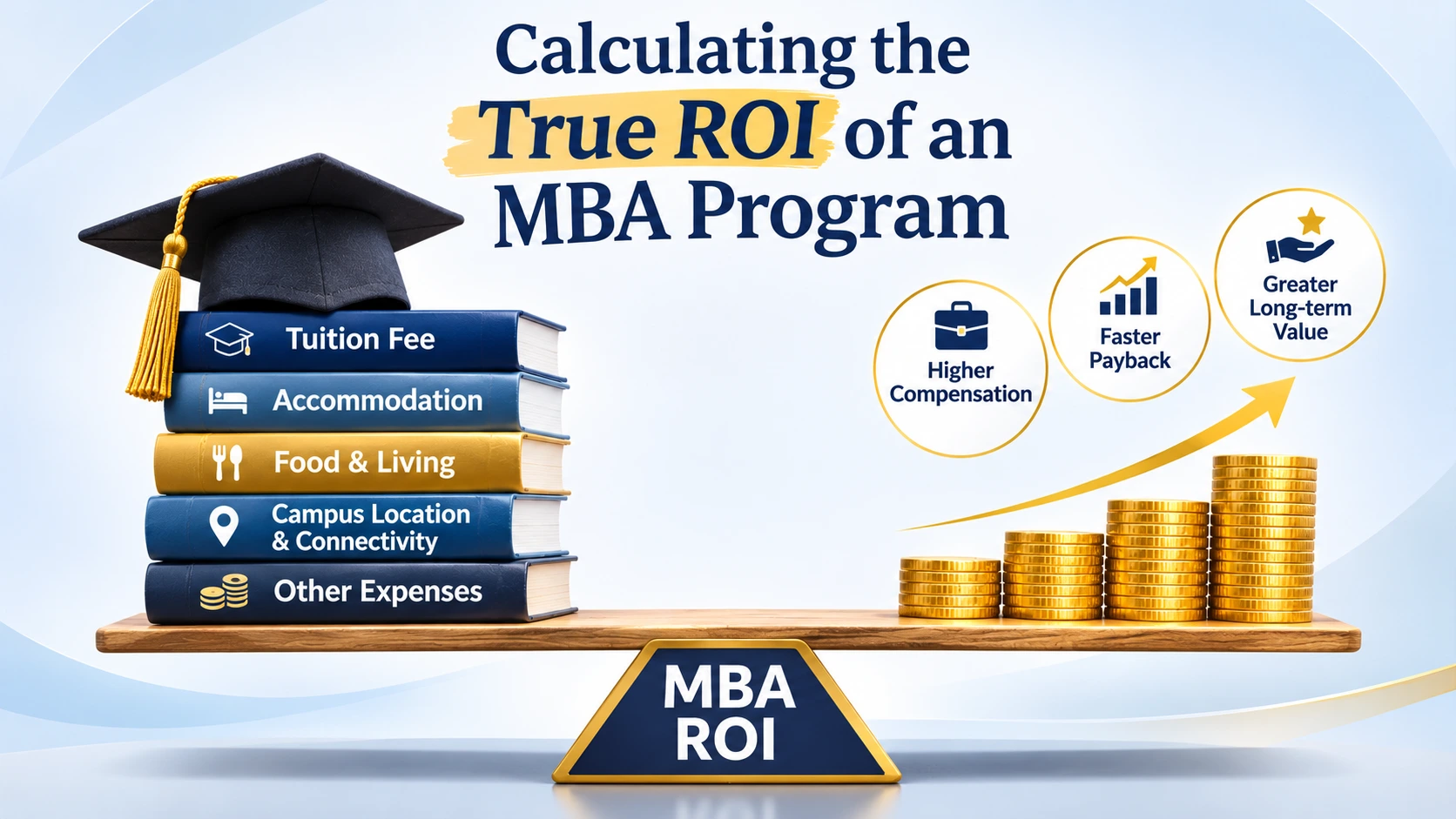
Calculating the true ROI of an MBA Program / Actual ROI of an MBA
Candidates preparing to enter MBA programs are often misled by the advertised fees declared by institutions. A more comprehensive and realistic return on investment must incorporate all costs, including accommodation, food, and miscellaneous expenses associated with the campus location.
 Ajai was successful in securing admission offers from two top business schools to their MBA programs. The first one was advertised at a fee of Rupees 21 lakhs and an average package of Rs 20 lakhs. The second business school’s fee was Rs 23 lakh, and the average package was Rs 18 lakh. Ajai and his parents wanted to opt for the school that offered the best value for the money. If you were in their shoes, which business school would you select? Well, the answer is not so straightforward. The devil lies in detail!
What if I tell you that the advertised fee for Rs 21 lakh for the first business school includes only the tuition fee, and you will have to pay additional money for accommodation and food for the next two years, whereas the advertised fee of the second school includes boarding and lodging, meaning that you do not need to spend anything additional over the next two years! Now, consider that boarding and lodging expenses for a top business school in a tier-1 city can range anywhere between Rs 4.5 to 6 Lakh Rupees for two years. How does this change the return on investment calculation?
In the absence of fee details, it seemed that the first business school offered a better ROI, as the payback period for the program fee was just over 1 year, whereas the second business school had a much longer payback period. However, after deducting boarding and lodging, the comparable fee for the second business school ranges from Rs 17 lakh to Rs 18.5 lakh. With a payback period of under 1 year, the second business school offer a much better ROI if all the costs associated with an MBA program are accounted for!
Advertised fees: The incomplete truth
Business schools can make their MBA programs look more affordable than competitors’ by advertising a lower fee that covers only tuition. The tuition fee, in most cases, covers tuition, examinations, library access, and other academic facilities, but excludes boarding and lodging, which constitute high and unavoidable costs of a full-time residential program. These charges, when payable in addition to the tuition fee, act as hidden charges for the MBA degree. These hidden charges have implications beyond affordability for the students and their parents. Indian families plan well in advance to finance their children’s education through savings or an education loan. A lack of clarity about the total expenditure of an MBA program leads to inadequate financial planning and last-minute financial adjustments, resulting in psychological pressure and the unreasonable cost of additional financing arranged at the eleventh hour.
Campus location: An overlooked cost component
The location of an institution is discussed in the context of accessibility, connectivity, and quality of life, but its impact on the overall cost of education is often underestimated. A robust MBA program supplements in-class and on-campus activities with frequent, meaningful interactions with external stakeholders, including alumni, potential recruiters, and society at large. Students need to frequently travel off campus to carry out these interactions. Students leave campus to procure products and services from external vendors, conduct field research, interact with industry, and engage with consumers and other stakeholders. If the campus is located closer to the city, students have better access to products and services, commercial establishments, industry, and public transport options. They can avail of these options conveniently and economically compared to when the campus is situated far from a sizeable urban centre. The quantitative impact may be assessed by the additional expenses they incur. The qualitative impact may be assessed in terms of lost opportunities to engage with alumni, industry, consumers and other stakeholders, resulting in sub-optimal learning outcomes. Thus, the location of a campus has a direct impact on the cost and quality of an MBA program.
Having a relook at the ROI:
It is fair and logical to assess the ROI of an MBA program, given that the decision has significant financial and career implications for students. ROI calculation depends on the returns reflected in the average package after an MBA and the cost of that MBA program. Business schools publicly announce their placement outcomes and average packages. A lot has already been said and written about placement numbers. But the cost of an MBA also deserves an equally meticulous scrutiny. A business school claiming a higher average package may seem to offer a higher ROI, but the calculation can change significantly if boarding, lodging, and connectivity charges are included. A comprehensive assessment of the true value of an MBA program would examine the post-MBA compensation package, total cost of the MBA program, and the time required to recover the investment.
Taking a rational decision
Even this ROI calculation comes with a word of caution! ROI is a good indicator, but not the only one, of a good MBA program. ROI calculation must be supplemented with non-financial parameters while selecting a business school. These parameters include the quality of the peer group, the size and strength of the alumni network, the quality of the faculty, and opportunities for professional development. It is important for students and families to adopt a more comprehensive approach when assessing business schools by carefully scrutinizing placement numbers, exploring the total cost of the program, and evaluating the long-term impact of the institution, its faculty, curriculum, pedagogy, and network on students’ lives and careers.
Institute of Management Technology, Ghaziabad
Raj Nagar, Post Box No. 137, Ghaziabad, Delhi NCR 201001, India
admissions@imt.edu · 0120-4083306 · 0120-4083380 · 9810214551
