
Fellow Program in Management (FPM)
A rigorous, research-intensive residential doctoral program designed to develop high-impact scholars,
researchers, and faculty for academia and research-driven institutions.
Equivalent to PhD. Recognized by the Association of Indian Universities (AIU)
Application Deadline Phase 1 : April 3, 2026
About the FPM Program
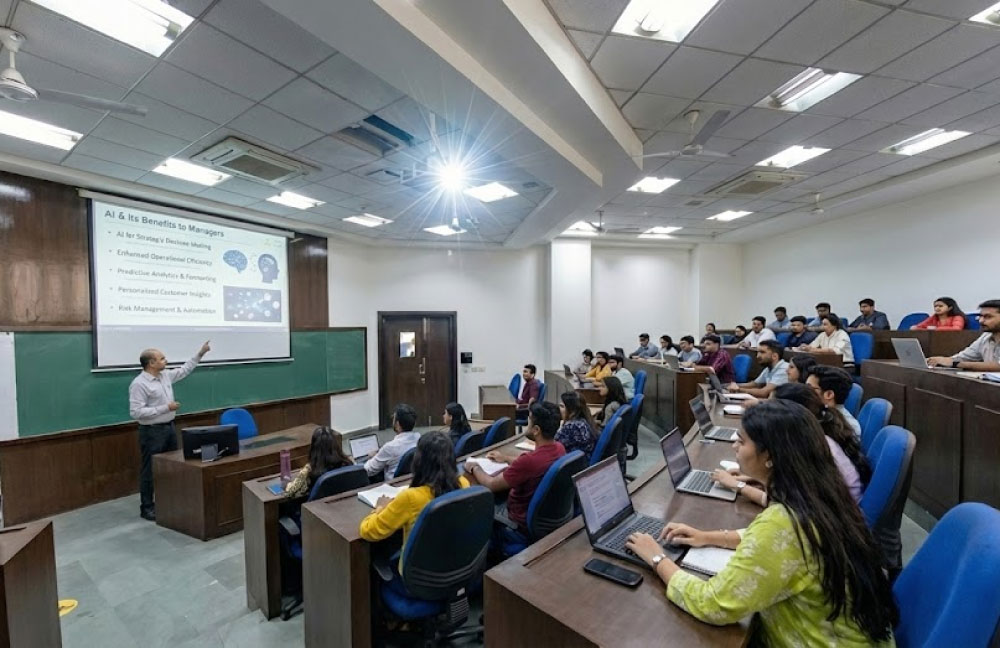
The Fellow Program in Management (FPM) at IMT Ghaziabad is a full-time, residential doctoral program focused on creating intellectual capital through high-quality research. The program prepares scholars for academic careers, research roles in industry, and thought leadership positions.
The FPM emphasizes doctoral coursework, research methodology, close faculty mentorship, and sustained engagement with contemporary management and social science research.
Why FPM at IMT Ghaziabad




PROGRAM HIGHLIGHTS

Accreditation
AACSB and NBA accredited institute
Approvals
Equivalent to PhD and recognised by AIU, AICTE approved full time doctoral program
Research
Experiential research training of international standards
Learning
Opportunity for interdisciplinary learnings and research
Duration
Duration of the program is 4 years
Stipend
Competitive stipend of INR 54,000 Per month


AREAS OF SPECIALISATIONS
Business Analytics
Economics and Sustainability
Finance
Information Technology Management
Marketing Management
Operations Management
Human Resource Management
Strategy Innovation, and Entrepreneurship
ELIGIBILITY, SELECTION PROCESS AND ADMISSION CYCLES
Eligibility criteria
- Minimum 60% marks in 10th, 12th, and Bachelor’s degree
- Master’s degree or equivalent in any discipline (minimum 60%)
- OR
- Five-year integrated Master’s Degree Program in any discipline (minimum 60%)
- OR
- Graduate degree with a minimum of 60% marks and a professional qualification like CA, CMA, CS, with at least 50% marks
- Test scores of CAT/GMAT/GRE/GATE/UGC-NET/JRF
- ECAT/XAT/GMAT/GRE- (Last 5-year scores would be considered (June 1, 2021 - May 31, 2026)
- ENET/UGC Exam taken from the year 2024 onwards would be considered valid
NOTE :
- Candidates applying to FPM program should not exceed 45 years of age on March 31, 2026.
- Candidates who are in final year of master’s program will be allowed to join the program provisionally subject to the submission of certificate issued on or before September 30,2026.
Selection Process
Verification of Documents
Research Aptitude Test
Multi-Level Interviews
Round 1: FPM Selection Committee Interview
Round 2: FPM Committee Interview
Final Round Interview
| Month | Deadline of Application | Tentative Date for Interviews |
|---|---|---|
| April | 03-April-2026 | 08-Apr-2026 |
April
Deadline: 03-April-2026
Interview: 08-Apr-2026
Coursework
- PGDM Courses
- Research Method Courses
- Discipline based doctroal courses
FPM - PAPERS IN PEER-REVIEWED JOURNALS
| FPM Students Co-author(s) | Name of Faculty Co-author(s) (Prof/Dr/Mr/Ms) | Title of Publication | Name of Journal | Publisher of Journal |
|---|---|---|---|---|
| Shipra Shaiwalini | Gunjan Malhotra | Exploring the lived experiences of internal migrant gig workers through the lens of the Capability Approach | European Journal of Work and Organizational Psychology | Routledge: Taylor & Francis Group |
| Gunjan Dandotiya | Gunjan Malhotra | Investigating the impact of conspicuous value on luxury rental purchase intention | Journal of Product & Brand Management | Emerald Group Publication Limited |
| Shipra Shaiwalini | — | Unpacking the gig economy: key enablers and barriers for gig work – a systematic review and future research directions | Personnel Review | Emerald Group Publication Limited |
| Damini Gera | — | Revolutionizing Talent Acquisition: A Conceptual Exploration of Artificial Intelligence in the Digital Era | TANZ Journal | Friedrich Berlin Verlagsgesellschaft mbH |
| FPM Students Co-author(s) | Name of Faculty Co-author(s) (Prof/Dr/Mr/Ms) | Title of Publication | Name of Journal | Publisher of Journal |
|---|---|---|---|---|
| 1. Agnitra Das Sarma | – | Impact of CSR Investments on the Financial Performance of a Firm: The Case of Government Mandate | TANZ Journal | Friedrich Berlin Verlagsgesellschaft mbH |
| 1. Gunjan Dandotiya | Juhi Gahlot Sarkar & Abhigyan Sarkar | Comprehending roles of virtual service assistant’s warmth and competence for service co-creation versus service recovery | Journal of Services Marketing | Emerald Group Publication Limited |
| 1. Gunjan Dandotiya | Abhigyan Sarkar & Juhi Gahlot Sarkar | Examining how consumers can love brands through internal storytelling | Journal of Consumer Marketing | Emerald Group Publication Limited |
| 1. Agnitra Das Sarma; 2. Damini Gera | – | Are Workplace Spirituality and Religious Spirituality really Different? A Qualitative Comparison of Literature and In-depth Interviews | Bulletin For Technology And History | Bulletin For Technology And History |
| 1. Abhijeet Tewary | – | Proposing a 6R framework promoting circular strategies for platform organizations | Digital Policy, Regulation and Governance | Emerald Group Publication Limited |
| 1. Agnitra Das Sarma | Juhi Gahlot Sarkar & Abhigyan Sarkar | E-tail format, cognitive orientation and device: shaping variety’s impact on online cart abandonment | Journal of Consumer Marketing | Emerald Group Publication Limited |
| 1. Adnan Khan | Ashish Varma | Accounting-Analytic Capabilities’ Impact on Management Controls and Performance | Journal of Computer Information Systems | Routledge: Taylor & Francis Group |
| 1. Komaragiri Hyndhavi | – | Diet Management Study on Indian Population Through Optimization Models—The Way Towards Reaching Blue Zone’s Lifestyle | Journal of Modern Applied Statistical Methods | Wayne State University Press |
| FPM Students Co-author(s) | Name of Faculty Co-author(s) (Prof/Dr/Mr/Ms) | Title of Publication | Name of Journal | Publisher of Journal |
|---|---|---|---|---|
| 1. Adnan Khan | Ashish Varma | Simons levers of control disentangled: A quasi-experiment into the competitiveness of hybrid firms | Management Control | Franco Angeli |
| 1. Gunjan Dandotiya | Gunjan Malhotra | Unpacking the influence of anthropomorphism and stereotypes on consumer attitude towards luxury brand | International Journal of Retail & Distribution Management | Emerald Group Publication Limited |
| 1. Shreya Kaushik | Ashish Varma | Professional skepticism for green reputation clients: A mixed method study of technology enabled audits | The International Journal of Digital Accounting Research | Rutgers University |
| 1. Shreya Kaushik | Ashish Varma | Sustainability reporting: How consistency and interdependence in financial and managerial accounting enhance eco-controls | Journal of Public Affairs | Wiley Publication |
| 1. Shipra Shaiwalini | Gunjan Malhotra | Environmental concern and purchase intention of pre-loved luxury products: a moderated mediation model | Asia Pacific Journal of Marketing and Logistics | Emerald Group Publication Limited |
| 1. Abhijeet Tewary; 2. Vaishali Jadon | – | Building a competent workforce in implementing Quality 4.0: a systematic literature review and proposed agenda for future research | The TQM Journal | Emerald Group Publication Limited |
| 1. Adnan Khan | Ashish Varma | Supply chain driven herding behavior during COVID-19: evidence of interdependence from India | Journal of Business & Industrial Marketing | Emerald Group Publication Limited |
| 1. Abhijeet Tewary | – | Analyzing the interplay between social media analytics and nudges in pandemic control | International Journal of Information Management Data Insights | Elsevier |
| 1. Gunjan Dandotiya; 2. Shipra Shaiwalini; 3. Adnan Khan; 4. Shreya Homechaudhuri | Gunjan Malhotra | Benchmarking for organisational competitiveness: a resource-based view perspective | Benchmarking: An International Journal | Emerald Group Publication Limited |
ENGAGING LEARNING ENVIRONMENT
| Title of the Activity | Date | Venue | Academic Year | Organizing Body | National/ International |
|---|---|---|---|---|---|
| International Conference on Emerging trends in Supply Chain and Operations | 25 – 27 July, 2022 | ONLINE | 2022-23 | Institute of Management Technology Ghaziabad & POMS India Chapter | International |
| MANLIBNET 2023: 21st International Conference on ‘Empowering Libraries, Connecting Communities: Innovation, Collaboration, and Entrepreneurship’ | 05 – 07 October, 2023 | Institute of Management Technology Ghaziabad | 2023-24 | Institute of Management Technology Ghaziabad | International |
| XXVII Annual International Conference of the Society of Operations Management on ‘Reinventing Future Supply Chains Through Climate Adaption, Agility, and Responsibility’ | 19 – 21 December, 2024 | Institute of Management Technology Ghaziabad | 2024-25 | Institute of Management Technology Ghaziabad | International |
| Title of the Activity | Date | Venue | Organizing Body | Academic Year | Resource Person |
|---|---|---|---|---|---|
| Research Capability Development Workshop | 14 July, 2022 | Institute of Management Technology Ghaziabad | Institute of Management Technology Ghaziabad | 2022-23 | Dr. Justin Paul ((Ph.D), Editor in Chief, International Journal of Consumer Studies & Professor University of Puerto Rico, USA and honorary Visiting Professor at Henley Business school, University of Reading, England) |
| Teaching Capability Development Workshop | 25 July, 2022 | Institute of Management Technology Ghaziabad | Institute of Management Technology Ghaziabad | 2022-23 | Dr. Saral Mukherjee (Faculty at IIM Ahmedabad and the Winner of Best Professor award at IIM Ahmedabad for eight consecutive years) |
| Research Workshop | 09 August, 2022 | Institute of Management Technology Ghaziabad | Institute of Management Technology Ghaziabad | 2022-23 | Dr. K. Mathiyazhagan (Chairperson – Research Center, Associate Professor, Thiagarajar School of Management) |
| Joint Workshop on Industry 4.0: Driving Towards Digital Transformation across Organizations | 24 August, 2022 | ONLINE | Institute of Management Technology Ghaziabad & SIAM | 2022-23 | Prof. Vishal Talwar, Program Convener (Faculty, IMT Ghaziabad Prof. Ratri Parida, Program Coordinator (Faculty, IMT Ghaziabad) |
| AICTE training and Learning (ATAL) faculty development program on Supply Chain Modelling and Analytics | 12 – 23 September, 2022 | ONLINE (12-17 September, 2022) & Institute of Management Technology Ghaziabad (19-23 September, 2022) | Institute of Management Technology Ghaziabad | 2022-23 | [Prof. (Dr.) T. A. S. Vijayaraghvan (Professor, XLRI Jamshedpur) (Topic: Supply Chain Analytics-Introduction)]; [Dr. Sharad Kumar Goyal (Project Scientist, Forest Survey of India, Dehradun) (Topic: Geo-informatics Applications in Logistics)]; [Prof. S. K. Garg (Pro-VC, Delhi Technical University) (Topic: Supply Chain Management in Industry 4.0 Era)]; [Prof. Vinaytosh Misra (Gulf Medical University, UAE) (Topic: Health Care Supply Chain Analytics)]; [Mr. Mayank Daga (Principal Data Analyst, Capital One, Richmond, USA) (Topic: Application of Supply Chain Finance)]; [Mr. Prashant Nagpure (Advisor Digital Transformation, PricewaterhouseCoopers) (Topic: Short Case Studies in Modeling and Analytics in Supply Chain)]; [Prof. Santosh Kumar Shrivastava (Associate Professor, Department of Business Analytics, IMT Ghaziabad) (Topic: Text Analytics Using R)]; [Prof. Nitin Seth (Director, Indo-French Centre for Promotion of Advanced Research, Delhi) (Topic: Supply chain management: Sectoral perspective)]; [Dr. Neharika Sobti (Assistant Professor, Department of Finance, IMT Ghaziabad) (Topic: Predictive Analytics: Understanding Customer Demand)]; [Mr. Tushar Jaruhar (Founder SYMPLFYD Education Pvt. Ltd.) (Topic: ML and AI in Supply Chain through Python)]; [Mr. Harsh Goyal (Operation Research Analyst, BCG Consulting) (Topic: Network Optimization Using Python)]; [Prof. Mrinalini Shah (Professor, Department of Operations Management, IMT Ghaziabad)]; [Prof. Manoj Srivastava (Topic: Emerging Trend in Supply Chain)] & [Mr. Rajnish Kumar (GM Operations Research, CRIS HQ, Delhi) (Topic: AI, ML Applications in Indian Railways)] |
| Research Methods Workshop | 27 September, 2022 | Institute of Management Technology Ghaziabad | Institute of Management Technology Ghaziabad | 2022-23 | Dr. Amit Shankar (Assistant Professor, Department of Marketing, IIM Vishakapatnam) |
| Workshop on Frameworks of Consulting | 31 October – 01 November 2022 | Institute of Management Technology Ghaziabad | Institute of Management Technology Ghaziabad | 2022-23 | Mr. Raman Deep Singh (Director of Client Services, Progility Consulting) |
| Workshop on Framing a Research Problem | 03 January, 2023 | Institute of Management Technology Ghaziabad | Institute of Management Technology Ghaziabad | 2022-23 | Dr. Abhinav Gupta (Michael G. Foster Endowed Fellow and Associate Professor of strategic management at the University of Washington’s Foster School of Business) |
| Paper Development Workshop: Crafting a Research Manuscript | 17 April, 2023 | Institute of Management Technology Ghaziabad | Institute of Management Technology Ghaziabad | 2022-23 | Prof. Om Narasimhan (Professor of Marketing, London School of Economics) |
| Workshop on Mediation and moderation analysis, Confirmatory Factor Analysis, Structural Equation Modelling | 12 – 13 June, 2023 | Institute of Management Technology Ghaziabad | Institute of Management Technology Ghaziabad | 2023-24 | Prof. Sreejesh (Associate Professor, Department of Marketing, Indian Institute of Management Kozhikode) |
| Workshop on Experiential Learning through games – pedagogical learning | 22 – 23 June, 2023 | Institute of Management Technology Ghaziabad | Institute of Management Technology Ghaziabad | 2023-24 | Dr. Rik Paul (Deputy Director, BML Munjal University, Ph.D. in Marketing) |
| Workshop on Teaching for Tomorrow: Elevating the Student Experience in Intense Classes | 07 July, 2023 | Institute of Management Technology Ghaziabad | Institute of Management Technology Ghaziabad | 2023-24 | Dr Uwe Seebacher (Professor for Marketing and Communications, FH WKW Vienna, Austria) |
| Workshop on Teaching Excellence | 24 July, 2023 | Institute of Management Technology Ghaziabad | Institute of Management Technology Ghaziabad | 2023-24 | Prof. Rajeev Kumra (Professor for Marketing at IIM Lucknow and Dean IIM (Noida Campus)) |
| Workshop on Industry 4.0 | 09 August, 2023 | Institute of Management Technology Ghaziabad | Institute of Management Technology Ghaziabad | 2023-24 | Moderator [Mr Avinash Kulkarni, Global-Head Cloud Business, Intense Technologies] & Distinguished keynote speaker [Prof. Radha Mohan Gupta, (Faculty, IMT Ghaziabad)] |
| Workshop on Business Visualisation with Tableau | September, 2023 | Institute of Management Technology Ghaziabad | Institute of Management Technology Ghaziabad | 2023-24 | Mr. Rishabh Khampariya (Co-founder and Chief Mentor, edAnalytix) |
| Pre-Incubation Workshop | 21 – 23 October, 2023 | Institute of Management Technology Ghaziabad | Institute of Management Technology Ghaziabad | 2023-24 | Dr. Shiladitya Das Gupta (Strategy expert and visiting faculty at IIFT), Ms. Ritu Jain (Founder, Srishti Consulting) & Mr. Sagar Chandni (Start-up coach, trainer and facilitator) |
| Developing Research Ideas for a Better World | 30 – 31 October, 2023 | Institute of Management Technology Ghaziabad | Institute of Management Technology Ghaziabad | 2023-24 | Dr. Rajesh Chandy (Professor of Marketing, Tony Maureen Wheeler Chair in Entrepreneurship & Academic Director, Wheeler Institute for Business and Development, London Business School) & Prof. Om Narasimhan (Professor of Marketing, Department of Management, London School of Economics) |
| Developing Conceptual Papers | 13 – 14 December, 2023 | Institute of Management Technology Ghaziabad | Institute of Management Technology Ghaziabad | 2023-24 | Dr. Atul Parvatiyar (Professor of Practice, Marketing & Supply Chain Management Area, Rawls College of Business Administration, Texas Tech University, Lubbock, TX) |
| The Craft of Writing for Management (and Business) Journals | 19 December, 2023 | Institute of Management Technology Ghaziabad | Institute of Management Technology Ghaziabad | 2023-24 | Dr. Vishal K. Gupta (Professor of Management, The University of Alabama) |
| Conducting Rigorous Multi-method Research | 04 January, 2024 | Institute of Management Technology Ghaziabad | Institute of Management Technology Ghaziabad | 2023-24 | Prof. Vamsi Kannuri (Viola D. Hank Associate Professor of Marketing, University of Notre Dame) |
| Harmonizing consumer preferences: Using the experiment method | 15 May, 2024 | Institute of Management Technology Ghaziabad | Institute of Management Technology Ghaziabad | 2023-24 | Dr. Alisha Dhal (Faculty, IMT Ghaziabad) |
| Gender-based Violence Research | 15 May, 2024 | Institute of Management Technology Ghaziabad | Institute of Management Technology Ghaziabad | 2023-24 | Dr. Poonam Barhoi (Faculty, IMT Ghaziabad) |
| Workshop on Experiential Learning through games – pedagogical learning | 03 – 04 June, 2024 | Institute of Management Technology Ghaziabad | Institute of Management Technology Ghaziabad | 2024-25 | Dr. Rik Paul (Deputy Director, BML Munjal University, Ph.D. in Marketing) |
| Crafting a Qualitative Inquiry | 07 – 09 June, 2024 | Institute of Management Technology Ghaziabad | Institute of Management Technology Ghaziabad | 2024-25 | Prof. Rohit Varman (Professor of Marketing and Consumption, Birmingham Business School, University of Birmingham), Prof. Devi Vijay (Professor of Organizational Behavior, IIM Calcutta) & Prof. Pradeep Hota (Professor of Business Policy and Strategy , IIM Udaipur) |
| Experimental Design and Implementation | 19 July, 2024 | Institute of Management Technology Ghaziabad | Institute of Management Technology Ghaziabad | 2024-25 | Prof. Nitika Garg (Professor of School of Marketing & Chair, Business School SDG Committee, UNSW Business School, UNSW Sydney) |
| Private Seminar on Teaching with Cases | 25 – 26 August, 2025 | Institute of Management Technology Ghaziabad | Institute of Management Technology Ghaziabad | 2025-26 | Prof. V G Narayanan (Thomas D. Casserly Jr. Professor of Business Administration at Harvard Business School and an expert in case method) |
FACULTY RESEARCH AND PUBLICATION
- Business Analytics
- Economics and Sustainability
- Finance
- Human Resource Management
- Information Technology Management
- Marketing Management
- Operations Management
- Strategy, Innovation and Entrepreneurship
| Name of Faculty Member (Prof/Dr/Mr/Ms) | FT 50 Listing/ ABDC Classification | Reference |
| Rajeev Kumar Ray | A | Ray, R. K., Vyas, I., Chandwani, R., & Kumar, M. (2025). Mental Health Consumption: Tracing the Past and Preparing for the Future in a Digital Age. Journal of Consumer Behaviour, Published Online. http://doi.org/10.1002/cb.70078 |
| Santosh Kumar Shrivastav | A | Bag, S., Rahman, M. S., Ghai, S., Shrivastav, S. K., Singh, R. K., & Mishra, R. (2024). Unveiling the impact of carbon-neutral policies on vital resources in Industry 4.0 driven smart manufacturing: A data-driven investigation. Computers & Industrial Engineering, 187(January). http://doi.org/10.1016/j.cie.2023.109798 |
| Santosh Kumar Shrivastav | A | Bag, S., Rahman, M. S., Routray, S., Shrivastav, S. K., & Agrawal, S. (2024). Exploring the Potential of Blockchain-Enabled Smart Contracts for Achieving Net Zero Emissions: An Empirical Study. Business Strategy and the Environment, 33(5), 3965-3985. |
| Santosh Kumar Shrivastav | A | Bag, S., Rahman, M. S., Sharma, J., Chiarini, A., Shrivastav, S. K., & Gupta, S. (2025). Building digital technology and innovative lean management capabilities for enhancing operational performance: an empirical study. Production Planning & Control: The Management of Operations, 36(8), 1009-1028. |
| Santosh Kumar Shrivastav | A | Bag, S., Rahman, M. S., Srivastava, A. K., Shrivastav, S. K., & Naude, P. (2024). Investigating the Overdependence on Supply Chain Partners, Exploitation, and Willingness to Focus on Sustainability Performance in Business-to-Business Firms. Organization & Environment, 37(4), 549-580. |
| Santosh Kumar Shrivastav | A | Bag, S., Routray, S., Rahman, M. S., & Shrivastav, S. K. (2025). Investigate the effect of green hydrogen supply chain integration on supply chain resilience: Organization information processing theory perspective. International Journal of Production Economics, 284(June). http://doi.org/10.1016/j.ijpe.2025.109613 |
| Santosh Kumar Shrivastav | A | Bag, S., Routray, S., Shrivastav, S. K., Roubaud, D., Benabdellah, A. C., & Grebinevych, O. (2024). Utilizing Artificial Intelligence for Stakeholder Engagement and Social Innovation in Addressing Climate Change: A Conceptual Framework and Future Research Agenda. Journal of Global Information Management, 32(1). http://doi.org/10.4018/JGIM.366588 |
| Santosh Kumar Shrivastav | A | Jadiyappa, N., Hickman, L. E., Shrivastav, S. K., Rajpal, H., & Kaur, N. (2024). Bank-Affiliated Directors’ Monitoring, Earnings Management, and Financial Reporting Quality in Emerging Markets: Evidence from India. Emerging Markets Review, 62(September). http://doi.org/10.1016/j.ememar.2024.101184 |
| Santosh Kumar Shrivastav | A | Shrivastav, S. K. (2023). Recent trends in supply chain management of business-to-business firms: a review and future research directions. Journal of Business & Industrial Marketing, 38(12), 2673-2693. |
| Santosh Kumar Shrivastav | A | Shrivastav, S. K., & Bag, S. (2023). Recent Developments on Flexible Manufacturing in the Digital Era: A Review and Future Research Directions. Global Journal of Flexible Systems Management, 24(4), 483-516. |
| Santosh Kumar Shrivastav | A | Shrivastav, S. K., & Bag, S. (2024). Blockchain Technology in Circular Economy: Unpacking the Potential Issues and Critical Echoes Through Data Triangulation and Natural Language Processing. Business Strategy and the Environment, 33(6), 5463-5484. |
| Santosh Kumar Shrivastav | A | Shrivastav, S. K., Bag, S., & Bhattacharya, R. (2025). Sustainable knowledge management in the digital era: leveraging natural language processing to identify trends, challenges and future directions. Journal of Knowledge Management, Published Online. http://doi.org/10.1108/JKM-10-2024-1251 |
| Santosh Kumar Shrivastav | A | Shrivastav, S. K., Routray, S., Bag, S., Gupta, S., & Zhang, J. Z. (2024). Exploring the Potential of Large Language Models in Supply Chain Management: A Study Using Big Data. Journal of Global Information Management, 32(1), 1-29. |
| Santosh Kumar Shrivastav | A | Srivastava, G., Bag, S., Ramudu, P. J., Shrivastav, S. K., Pueschel, J., & Benabdellah, A. C. (2025). Theoretical Perspectives on the Impact of Generative AI on the Tourism Sector: A Literature Review. Journal of Global Information Management, 33(1). http://doi.org/10.4018/JGIM.388177 |
| Santosh Kumar Shrivastav | B | Bag, S., Rahman, M. S., Srivastava, G., & Shrivastav, S. K. (2025). Unveiling metaverse potential in supply chain management and overcoming implementation challenges: an empirical study. Benchmarking: An International Journal, 32(11), 79-108. |
| Santosh Kumar Shrivastav | B | Chaklader, B., Chaklader, G., & Shrivastav, S. K. (2024). Impact of environmental, social and governance (ESG) on foreign institutional investments in India: a machine learning perspective. Benchmarking: An International Journal, Published Online. http://doi.org/10.1108/BIJ-12-2023-0910 |
| Santosh Kumar Shrivastav | B | Kumar, A., Shrivastav, S. K., & Bhattacharyya, S. (2023). Measuring strategic fit using big data analytics in the automotive supply chain: a data source triangulation-based research. International Journal of Productivity and Performance Management, 72(10), 2977-2999. |
| Santosh Kumar Shrivastav | B | Shrivastav, S. K. (2023). How The TQM Journal has addressed “quality”: a literature review using bibliometric analysis. The TQM Journal, 35(8), 2640-2657. |
| Santosh Kumar Shrivastav | B | Shrivastav, S. K., & Bag, S. (2024). Humanitarian supply chain management in the digital age: a hybrid review using published literature and social media data. Benchmarking: An International Journal, 31(7), 2267-2301. |
| Santosh Kumar Shrivastav | B | Shrivastav, S. K., & Sareen, A. (2024). Exploring the use of artificial intelligence in humanitarian supply chain: empirical evidence using user-generated contents. Benchmarking: An International Journal, Published Online. http://doi.org/10.1108/bij-04-2024-0275 |
| Santosh Kumar Shrivastav | C | Ramudu, P. J., & Shrivastav, S. K. (2022). Opportunities and Required Skills in Data-Driven Jobs: Empirical Evidence from Indian Job Markets. Advances and Applications in Statistics, 82, 101-124. http://doi.org/10.17654/0972361722082 |
| Santosh Kumar Shrivastav | C | Sharma, J., Shrivastav, S. K., & Tyagi, S. (2022). Factors determining COVID-19 vaccine acceptance: an empirical investigation from India. Advances and Applications in Statistics, 79, 25-54. http://doi.org/10.17654/0972361722058 |
| Santosh Kumar Shrivastav | C | Shrivastav, S. K. (2023). Exploring the application of analytics in supply chain during COVID-19 pandemic: a review and future research agenda. Journal of Global Operations and Strategic Sourcing, 16(2), 492-519. |
| Sapna Tyagi | A | Khan, M. A., Alluhaidan, A. S., Alharthi, A., Alqarni, A., & Tyagi, S. (2025). Dynamic Secure Multi-Access Scheme for Interaction in Internet of Vehicles. IEEE Transactions on Vehicular Technology, 74(1), 1322-1334. |
| Sapna Tyagi | A | Paul, J., Ueno, A., Dennis, C., Alamanos, E., Curtis, L., Foroudi, P., Kacprzak, A., Kunz, W. H., Liu, J., Marvi, R., Nair, S. L. S., Ozdemir, O., Pantano, E., Papadopoulos, T., Petit, O., Tyagi, S., & Wirtz, J. (2024). Digital transformation: A multidisciplinary perspective and future research agenda. International Journal of Consumer Studies, 48(2), 1-28. |
| Sapna Tyagi | A | Tyagi, S., Bag, S., Oberoi, S. S., Banerjee, S., & Benabdellah, A. C. (2024). Transforming Food Systems: A Comprehensive Review and Research Agenda for Digital Technologies in Circular and Sustainable SC. Journal of Global Information Management, 32(1). http://doi.org/10.4018/JGIM.349962 |
| Sapna Tyagi | B | Tyagi, S. (2024). Analytics in healthcare supply chain management in the new normal era: a review and future research agenda. Benchmarking: An International Journal, 31(6), 2151-2175. |
| Sapna Tyagi | C | Sharma, J., Shrivastav, S. K., & Tyagi, S. (2022). Factors determining COVID-19 vaccine acceptance: an empirical investigation from India. Advances and Applications in Statistics, 79, 25-54. http://doi.org/10.17654/0972361722058 |
| Name of Faculty Member (Prof/Dr/Mr/Ms) | FT 50 Listing/ ABDC Classification | Reference |
| Akarsh Arora | B | Arora, A. (2024). Epicentre of Multidimensional Poverty: A Regional Analysis of Uttar Pradesh. Economic & Political Weekly, LIX(14), 59-68. |
| Akarsh Arora | B | Arora, A., & Siddiqui, M. Z. (2025). Multidimensional Poverty Disparities among Social Groups. Economic & Political Weekly, LX(9), 31-40. |
| Akarsh Arora | B | Arora, A., & Singh, S. P. (2025). Multidimensional poverty at the epicentre: analysing socio-religious disparities in Uttar Pradesh, India. Indian Growth and Development Review, 18(1), 112-131. |
| Akarsh Arora | C | Ralph, A., & Arora, A. (2024). Mapping the literature on decent work: A bibliometric analysis of sustainable development goal 8. Sustainable Development, 32(4), 3937-3952. |
| Amrita Kamalini Bhattacharyya | B | Sinha, S. K., Mukhopadhyay, S., Upadhyay, P., Dwivedi, Y. K., Bhattacharyya, S., Paul, M., & Bhattacharyya, A. K. (2023). Challenges and opportunities in IT transformation of public service delivery: case of India Post. Transforming Government: People, Process and Policy, 17(1), 134-146. |
| Kasturi Das | A | Das, K., & Bandyopadhyay, K. R. (2025). Impact of carbon border adjustment mechanism (CBAM) on steel decarbonization in India: a multi-stakeholder perspective on ambition vs. equity. International Environmental Agreements: Politics, Law and Economics, 25(2), 195-229. |
| Kasturi Das | B | Bandyopadhyay, K. R., & Das, K. (2023). Navigating ESG Disclosure and Ratings’ Conundrum: Reflections on the SEBI’s Proposed Framework. Economic & Political Weekly, 58(25-26), 57-64. |
| Kasturi Das | B | Bandyopadhyay, K. R., & Das, K. (2025). CBAM and Steel Decarbonisation in India: A Barrier, Facilitator, or Neither?. Economic & Political Weekly, LX(25), 30-37. |
| Manas Paul | A | Dar, A. B., Bhanja, N., Paul, M., & Farooq, U. (2024). Shaping a greener tomorrow: Analysing the impact of environment-friendly technology on ecological footprints in emerging asian economies. Journal of Cleaner Production, 452(May), 1-16. |
| Manas Paul | A | Kanjilal, K., Paul, M., & Ghosh, S. (2025). Hedging dynamics between oil and clean energy stock indices amid the Russia-Ukraine war and geopolitical turmoil. Finance Research Letters, 84(November). http://doi.org/10.1016/j.frl.2025.107753 |
| Manas Paul | A | Mukhopadhyay, S., Chauhan, S., Paul, M., Bhattacharyya, S., Upadhyay, P., & Sinha, S. K. (2025). Why do few organizations succeed while others fail? Impact of organizational capabilities and barriers on digital government transformation. Information Systems Frontiers, Published Online. http://doi.org/10.1007/s10796-025-10603-4 |
| Manas Paul | A | Parrey, Z. A., Dar, A. B., & Paul, M. (2025). Revisiting precious metal mining stocks and precious metals as hedge, diversifiers and safe-havens: a multidimensional scaling and wavelet quantile correlation perspective. Empirical Economics, 68(2), 511-533. |
| Manas Paul | B | Farooq, U., Paul, M., & Dar, A. B. (2024). On the nexus between growth and disaggregated ecological footprints-empirical evidence from India. Journal of Environmental Planning and Management, 67(7), 1461-1493. |
| Manas Paul | B | Paul, M., Bhanja, N., & Dar, A. B. (2023). On the similarities between precious metals, precious metal stocks and equities – International evidence for gold and silver. Resources Policy, 83(June), 1-10. |
| Manas Paul | B | Sinha, S. K., Mukhopadhyay, S., Upadhyay, P., Dwivedi, Y. K., Bhattacharyya, S., Paul, M., & Bhattacharyya, A. K. (2023). Challenges and opportunities in IT transformation of public service delivery: case of India Post. Transforming Government: People, Process and Policy, 17(1), 134-146. |
| Subhajit Bhattacharyya | A | Mukhopadhyay, S., Chauhan, S., Paul, M., Bhattacharyya, S., Upadhyay, P., & Sinha, S. K. (2025). Why do few organizations succeed while others fail? Impact of organizational capabilities and barriers on digital government transformation. Information Systems Frontiers, Published Online. http://doi.org/10.1007/s10796-025-10603-4 |
| Subhajit Bhattacharyya | B | Kumar, A., Shrivastav, S. K., & Bhattacharyya, S. (2023). Measuring strategic fit using big data analytics in the automotive supply chain: a data source triangulation-based research. International Journal of Productivity and Performance Management, 72(10), 2977-2999. |
| Subhajit Bhattacharyya | B | Sinha, S. K., Mukhopadhyay, S., Upadhyay, P., Dwivedi, Y. K., Bhattacharyya, S., Paul, M., & Bhattacharyya, A. K. (2023). Challenges and opportunities in IT transformation of public service delivery: case of India Post. Transforming Government: People, Process and Policy, 17(1), 134-146. |
| Vivek Jadhav | B | Jadhav, V. (2025). Political Regimes, Religious Dominance, and Economic Preferences: Insights from the World Values Survey and Global State of Democracy Indices. Social Science Quarterly, 106(1). http://doi.org/10.1111/ssqu.13482 |
| Vivek Jadhav | B | Jadhav, V. (2025). Visible inequality and the allocation of household spending: an empirical analysis from India. Indian Growth and Development Review, Published Online. http://doi.org/10.1108/IGDR-09-2024-0159 |
| Vivek Jadhav | B | Jadhav, V., & Mukherjee, S. (2024). Interplay of Status Perception, Visible Inequality, Conspicuous Consumption, and Food Expenditure: Evidence from Consumer Pyramid Household Survey of Indian Households. Economic Papers, 43(4), 342-369. |
| Vivek Jadhav | B | Jadhav, V., & Mukherjee, S. (2024). Nexus Between Political Concentration, Fractionalisation, Fiscal Federalism and Human Development: A State-wise Analysis. The Indian Economic Journal, Published Online. http://doi.org/10.1177/00194662241295534 |
| Vivek Jadhav | B | Jadhav, V., & Mukherjee, S. (2024). Poverty, inequality, and growth dynamics in Indian states: pre-COVID, COVID, and post-COVID insights from Consumer Pyramids Household Survey. Journal of the Asia Pacific Economy, Published Online. http://doi.org/10.1080/13547860.2024.2440232 |
| Vivek Jadhav | B | Mahambare, V., Dhanaraj, S., Jain, V., & Jadhav, V. (2025). Evaluating cash transfers and health advice impact on child health: evidence from lowperforming Indian states under Janani Suraksha Yojana. Indian Growth and Development Review, Published Online. http://doi.org/10.1108/IGDR-09-2024-0150 |
| Vivek Jadhav | C | Jadhav, V. (2024). Democracy, Dictatorship and People’s Beliefs: Evidence from the World Value Longitudinal Survey. Journal of Economic Integration, 39(4), 831-848. |
| Vivek Jadhav | C | Jadhav, V. (2024). Scale of Regionality, Spatial Dependence and Convergence: Evidence from 1346 sub-national regions using Spatial Econometric Models. Empirical Economics Letters, 23(4). http://doi.org/ – |
| Vivek Jadhav | C | Jadhav, V., & Mukherjee, S. (2024). Nexus between political federalism, social diversity and human development in India. Theoretical and Applied Economics, XXXI(1 (638)), 187-200. |
| Name of Faculty Member (Prof/Dr/Mr/Ms) | FT 50 Listing/ ABDC Classification | Reference |
| Arit Chaudhury | B | Chaudhury, A., & Dawar, V. (2025). A Novel Framework for Environmental, Social & Governance (ESG) Investing: The Case of Large Retail Investors in an Emerging Market. Qualitative Research in Financial Markets, Published Online. http://doi.org/10.1108/qrfm-09-2023-0211 |
| Arit Chaudhury | B | Chaudhury, A., Sahoo, S., & Dawar, V. (2024). Financial Analysts’ Forecast Accuracy, informativeness and its implications for market efficiency: Evidence from an emerging market. International Journal of Managerial and Financial Accounting, 16(2), 159-179. |
| Ashish Varma | A | Khan, A., Sindhwani, R., Atif, M., & Varma, A. (2024). Supply chain driven herding behavior during COVID-19: evidence of interdependence from India. Journal of Business & Industrial Marketing, 39(8), 1764-1787. |
| Ashish Varma | A | Varma, A., & Sharma, A. (2024). Assessing the Impact of Accounting Analytic Capabilities on Firm Performance. Journal of Computer Information Systems, Published Online. http://doi.org/10.1080/08874417.2024.2329137 |
| Ashish Varma | A | Varma, A., Sharma, A., & Khan, A. (2025). Accounting-Analytic Capabilities’ Impact on Management Controls and Performance. Journal of Computer Information Systems, Published Online. http://doi.org/10.1080/08874417.2024.2441770 |
| Ashish Varma | B | Varma, A., & Bhawalpuria, T. (2024). Accountability and governance in academia: a Foucauldian perspective on digital governance and control. International Journal of Educational Management, Published Online. http://doi.org/10.1108/ijem-10-2023-0518 |
| Ashish Varma | B | Varma, A., Mancini, D., & Kaushik, S. (2023). Professional skepticism for green reputation clients: A mixed method study of technology enabled audits. The International Journal of Digital Accounting Research, 23, 137-179. http://doi.org/10.4192/1577-8517-v23_6 |
| Ashish Varma | B | Varma, A., Mancini, D., & Kaushik, S. (2024). Sustainability reporting: How consistency and interdependence in financial and managerial accounting enhance eco-controls. Journal of Public Affairs, 24(1), 1-20. |
| Ashish Varma | C | Varma, A., & Khan, A. (2023). Simons levers of control disentangled: A quasi-experiment into the competitiveness of hybrid firms. Management Control, (2023/2), 19-41. |
| Barnali Chaklader | A | Chaklader, B., Gupta, B. B., & Panigrahi, P. K. (2023). Analyzing the progress of FINTECH-companies and their integration with new technologies for innovation and entrepreneurship. Journal of Business Research, 161(June), 1-11. |
| Barnali Chaklader | B | Chaklader, B., & Mundi, H. S. (2024). Do contingent liabilities affect dividend decisions?. Managerial Finance, 50(4), 734-747. |
| Barnali Chaklader | B | Chaklader, B., Chaklader, G., & Shrivastav, S. K. (2024). Impact of environmental, social and governance (ESG) on foreign institutional investments in India: a machine learning perspective. Benchmarking: An International Journal, Published Online. http://doi.org/10.1108/BIJ-12-2023-0910 |
| Barnali Chaklader | B | Gulati, P. A., & Chaklader, B. (2025). Impact of ripple effect in the semiconductor supply chain on the stock market: a signalling theory and resource dependence perspective. Benchmarking: An International Journal, Published Online. http://doi.org/10.1108/BIJ-07-2025-0730 |
| Barnali Chaklader | C | Chaklader, B., Srivatava, N., Sharma, V., & Sayeed, S. S. (2024). The Impact of Surplus, Promoter Holding, Leverage and Retained Earnings on Dividend Payment Decisions: Evidence from Small- and Mid-sized Firms in India. Global Business Review, Published Online. http://doi.org/10.1177/09721509231196630 |
| Hardeep Singh Mundi | A | Mundi, H. S. (2022). CEO social capital and capital structure complexity. Journal of Behavioral and Experimental Finance, 35(September), 1-11. |
| Hardeep Singh Mundi | A | Mundi, H. S. (2025). Financial incentives and tourist motivation: Understanding drivers of sustainable tourism. Tourism Management Perspectives, 58(September). http://doi.org/10.1016/j.tmp.2025.101403 |
| Hardeep Singh Mundi | A | Mundi, H. S., & Vashisht, S. (2023). Cognitive abilities and financial resilience: evidence from an emerging market. International Journal of Bank Marketing, 41(5), 1010-1036. |
| Hardeep Singh Mundi | A | Sengupta, S., & Mundi, H. S. (2025). Unveiling barriers and opportunities for LGBTQIA+ customer’s financial well-being. Journal of Services Marketing, 39(5), 531-550. |
| Hardeep Singh Mundi | A | Vashisht, S., & Mundi, H. S. (2025). Do well-connected bank CEOs mitigate the impact of geopolitical risk on bank stability? Evidence from an emerging market. Finance Research Letters, 84(November). http://doi.org/10.1016/j.frl.2025.107777 |
| Hardeep Singh Mundi | B | Chaklader, B., & Mundi, H. S. (2024). Do contingent liabilities affect dividend decisions?. Managerial Finance, 50(4), 734-747. |
| Hardeep Singh Mundi | B | Mundi, H. S. (2024). CEO social network, capital structure complexity and firm performance. Review of Behavioral Finance, 16(1), 96-111. |
| Hardeep Singh Mundi | B | Mundi, H. S. (2024). Complexity of gender to understand financial behavior. Financial behavior of transgender and cisgender individuals: evidence from India: a qualitative inquiry. Qualitative Research in Financial Markets, 16(1), 9-31. |
| Hardeep Singh Mundi | B | Mundi, H. S. (2025). ‘We’re All in This Together… Maybe Too Much?’: The Financial Enmeshment Scale. International Social Science Journal, 75(257), 573-584. |
| Hardeep Singh Mundi | B | Mundi, H. S. (2025). The equality equation: toward a rainbow-friendly financial sector in India. Equality, Diversity and Inclusion, Published Online. http://doi.org/10.1108/edi-07-2024-0339 |
| Hardeep Singh Mundi | B | Mundi, H. S., & Apergis, N. (2025). Enhancing Financial Well-Being: Solution-Focused Financial Therapy Intervention. International Social Science Journal, Published Online. http://doi.org/10.1111/issj.70013 |
| Hardeep Singh Mundi | B | Mundi, H. S., & Vashisht, S. (2024). Shed old baggage and invest wisely. A bibliometric and thematic analysis of disposition effect and investment. Qualitative Research in Financial Markets, 16(2), 355-379. |
| Hardeep Singh Mundi | B | Mundi, H. S., & Vashisht, S. (2025). Understanding financial toxicity in health care: voices of patients, hospitals and NGOs – empowering recovery through financial support. Qualitative Research in Financial Markets, Published Online. http://doi.org/10.1108/qrfm-05-2024-0130 |
| Hardeep Singh Mundi | B | Mundi, H. S., Vashisht, S., & Rao, M. (2025). A qualitative investigation into financial well-being and social capital of retired government school teachers. Qualitative Research in Financial Markets, 17(3), 576-603. |
| Hardeep Singh Mundi | B | Vashisht, S., Sarva, M., & Mundi, H. S. (2022). Risks measurement in banking: A bibliometric and content analysis. International Social Science Journal, 72(246), 955-977. |
| Hardeep Singh Mundi | C | Mundi, H. S., & Yadav, Y. (2023). Impact of COVID-19 on Market Sentiment and Abnormal Returns in India: A Comparative Analysis of Two Waves. FIIB Business Review, Published Online. http://doi.org/10.1177/23197145231161240 |
| Hardeep Singh Mundi | C | Mundi, H. S., Gautam, J., & Vasisht, S. (2023). Determinants of Capital Structure in the Hospitality Industry: Impact of Sector-Specific Performance Determinants on Capital Structure. The Journal of Hospitality Financial Management, 31(1), 19-31. |
| Harsimran Sandhu | A | Sandhu, H., & Deb, S. G. (2023). Do changes in distributors’ incentive structure drive mutual fund flows?. International Journal of Bank Marketing, 41(3), 508-526. |
| Harsimran Sandhu | A | Sandhu, H., & Deb, S. G. (2024). Ethical Dimensions of Bank-Distributed Mutual Funds. Economics Letters, 238(May), 1-3. |
| Harsimran Sandhu | A | Sandhu, H., & Deb, S. G. (2024). Nexus between AMCs and distributors and its impact on investor wealth. Economics Letters, 244(November). http://doi.org/10.1016/j.econlet.2024.112028 |
| Harsimran Sandhu | B | Sandhu, H. (2022). Low price anchors in equity market. Cogent Economics & Finance, 10(1), 1-19. |
| Puja Aggarwal Gulati | B | Gulati, P. A., & Chaklader, B. (2025). Impact of ripple effect in the semiconductor supply chain on the stock market: a signalling theory and resource dependence perspective. Benchmarking: An International Journal, Published Online. http://doi.org/10.1108/BIJ-07-2025-0730 |
| Puja Aggarwal Gulati | B | Gulati, P. A., & Garg, S. (2024). Impact of merger on stock returns and economic value added (EVA) of the acquiring firms: A study from Indian Corporate Sector. International Journal of Emerging Markets, 19(3), 649-664. |
| Ritesh Pandey | A | Agarwal, S., Pandey, R., Kumar, S., Lim, W. M., Agarwal, P. K., & Malik, A. (2023). Workplace incivility: A retrospective review and future research agenda. Safety Science, 158(February), 1-19. |
| Ritesh Pandey | B | Mukhopadhyay, S., Whalley, J., Pandey, R., & Ranganathan, V. (2024). Platform ecosystem research in the technology and innovation management discipline: a multi-method literature review. Benchmarking: An International Journal, 31(5), 1826-1850. |
| Ritesh Pandey | B | Singh, N., Pandey, R., Gupta, R., Biswas, B., & Gupta, S. (2024). Reverse knowledge transfer: making sense of two decades of academic research. VINE Journal of Information and Knowledge Management Systems, 54(5), 1092-1123. |
| Ritesh Pandey | C | Mukhopadhyay, S., Chauhan, S., Pandey, R., & Jain, S. (2025). The Effectiveness of Omnichannel Strategy: A Meta-analytical Approach. FIIB Business Review, Published Online. http://doi.org/10.1177/23197145251343708 |
| Sachin Choudhry | C | Cheung, R. W., Agrawal, R. K., & Choudhry, S. (2023). Do virtues matter? Accounting ethics education in Hong Kong. International Journal of Ethics and Systems, 39(4), 679-696. |
| Name of Faculty Member (Prof/Dr/Mr/Ms) | FT 50 Listing/ ABDC Classification | Reference |
| Bindu Gupta | FT 50 | Gupta, B., Dhoopar, A., Singh, R. K., & Puri, S. (2025). Salespeople moral disengagement and duty orientation: Examining the influence of peers’ unethical behavior and customer incivility. Journal of Business Ethics, Published Online. http://doi.org/10.1007/s10551-025-06010-z |
| Bindu Gupta | A* | Gupta, B., Bhardwaj, S., Srivastava, S., & Madan, P. (2024). Peers’ unethical behavior and employees’ discretionary behavior: Role of employees’ duty orientation. International Journal of Hospitality Management, 119(May), 1-12. |
| Bindu Gupta | A | Gupta, B., Dhoopar, A., & Srivastava, S. (2025). Does toxic leadership influence employees’ defensive and aggressive reactions: threat as a mediating mechanism. Personnel Review, 54(6), 1341-1367. |
| Bindu Gupta | B | Gupta, B., Sihag, P., & Pangtey, R. S. (2024). If I feel valued, I am committed to change: role of workplace dignity and perceived supervisor support. International Journal of Organizational Analysis, 32(6), 1022-1041. |
| Bindu Gupta | B | Gupta, B., Singh, A., & Sihag, P. (2025). Does self-leadership of expatriates drive their performance: mediating and moderating mechanism. International Journal of Productivity and Performance Management, Published Online. http://doi.org/10.1108/ijppm-06-2024-0416 |
| Bindu Gupta | B | Madan, P., Srivastava, S., & Gupta, B. (2025). Pathways from supervisor incivility to workplace deviance: the mediating role of emotional exhaustion and supervisor-targeted aggression. Journal of Organizational Effectiveness: People and Performance, Published Online. http://doi.org/10.1108/joepp-07-2024-0302 |
| Bindu Gupta | C | Dhoopar, A., Gupta, B., Sihag, P., & Goyal, K. (2025). Employee Turnover Intention: A Review and Research Agenda. Global Business and Organizational Excellence, Published Online. http://doi.org/10.1002/joe.70010 |
| Nidhi Yadav | A | Bhaskar, A. U., Mishra, B., Yadav, N., & Sinha, P. (2023). Who uses deceptive impression management to succeed at job interviews? The role of ethical ideologies and work locus of control. International Journal of Manpower, 44(3), 453-469. |
| Nidhi Yadav | B | Maji, S., Yadav, N., & Gupta, P. (2024). LGBTQ+ in workplace: a systematic review and reconsideration. Equality, Diversity and Inclusion, 43(2), 313-360. |
| Prerna Panda | B | Panda, P., & Singh, P. (2025). Examining how reverse mentoring influences innovative performance: evidence from the Indian IT sector during the COVID-19 pandemic. VINE Journal of Information and Knowledge Management Systems, Published Online. http://doi.org/10.1108/VJIKMS-10-2023-0258 |
| Prerna Panda | B | Panda, P., & Singh, P. (2025). Organizational virtuousness fosters innovative performance and pro-social behavior: examining the role of employee resilience and agility. Journal of Organizational Change Management, Published Online. http://doi.org/10.1108/jocm-02-2024-0073 |
| Prerna Panda | B | Panda, P., & Singh, P. (2025). Perceived organizational virtuousness and employee’s subjective well-being: examining the role of resilience, agility and collectivism. Management Decision, Published Online. http://doi.org/10.1108/md-01-2024-0076 |
| Richa Saxena | A | Goštautaitė, B., …Saxena, R.,… Zikic, B. (2025). Age and Career Resilience Through the Lens of Life Course Theory: Examining Individual Mechanisms and Macro‐Level Context Across 28 Countries. Human Resource Management Journal, Published Online. http://doi.org/10.1111/1748-8583.12596 |
| Warren Stanley Patrick | C | Patrick, W. S., Jha, J. K., Thakur, M., & Biswas, S. (2025). Staying put in a world of resignations, layoffs and moonlighting: unraveling the paradoxical puzzle. Management Research Review, 48(5), 709-725. |
| Name of Faculty Member (Prof/Dr/Mr/Ms) | FT 50 Listing/ ABDC Classification | Reference |
| Poonam Garg | A | Garg, P., Gupta, B., Kapil, K. N., Sivarajah, U., & Gupta, S. (2025). Examining the relationship between blockchain capabilities and organizational performance in the Indian banking sector. Annals of Operations Research, 348(3), 1513-1546. |
| Poonam Garg | A | Garg, P., Gupta, B., Sar, A., Graham, G., & Shore, A. P. (2024). Development and Validation of an Instrument to Measure the Perceived Benefits of Digitalization in Manufacturing. IEEE Transactions on Engineering Management, 71(4), 8288-8306. |
| Reema Khurana | A | Bag, S., Rahman, M. S., Routray, S., & Khurana, R. (2025). Regenerative supply chain orientation and coopetition in supply chain networks for ESG initiatives: A parallel mediation study. Journal of Business Research, 201(December). http://doi.org/10.1016/j.jbusres.2025.115685 |
| Reema Khurana | A | Gupta, R., Khurana, R., & Prashaant, A. (2024). Open banking on the horizon: a scientometric analysis and research agenda. Electronic Commerce Research, 24(1), 577-604. |
| Reema Khurana | B | Khurana, R., & Gupta, R. (2025). Digital Entrepreneurship by Women in Handloom Fashion: A Qualitative Case-based Study. Academy of Marketing Studies Journal, 29(2), 1-10. |
| Reema Khurana | C | Khurana, R. (2022). Artificial Intelligence as a Vehicle for Innovation: Literature Review and Bibliometric Study. Asia Pacific Journal of Information Systems, 32(4), 916-944. |
| Ruchi Payal | A | Sharma, N., Payal, R., & Paul, J. (2025). Hello! How Can I Help You? Role of Technology Appetite on AI Adoption in the Post-Pandemic Era. R&D Management, Published Online. http://doi.org/10.1111/radm.12771 |
| Ruchi Payal | C | Payal, R., Sharma, N., & Dwivedi, Y. K. (2024). Unlocking the impact of brand engagement in the metaverse on Real-World purchase intentions: Analyzing Pre-Adoption behavior in a futuristic technology platform. Electronic Commerce Research and Applications, 65(May-June), 1-16. |
| Susmi Routray | A* | Choudhary, P. K., Routray, S., Upadhyay, P., & Pani, A. K. (2022). Adoption of enterprise mobile systems – An alternative theoretical perspective. International Journal of Information Management, 67(December), 1-14. |
| Susmi Routray | A | Bag, S., Rahman, M. S., Routray, S., & Khurana, R. (2025). Regenerative supply chain orientation and coopetition in supply chain networks for ESG initiatives: A parallel mediation study. Journal of Business Research, 201(December). http://doi.org/10.1016/j.jbusres.2025.115685 |
| Susmi Routray | A | Bag, S., Rahman, M. S., Routray, S., Roubaud, D., & Mangla, S. K. (2025). Integrating Big Data and Artificial Intelligence Technology to Build Renewable Energy Supply Chain Resilience: An Empirical Study. Business Strategy and the Environment, Published Online. http://doi.org/10.1002/bse.70052 |
| Susmi Routray | A | Bag, S., Rahman, M. S., Routray, S., Shrivastav, S. K., & Agrawal, S. (2024). Exploring the Potential of Blockchain-Enabled Smart Contracts for Achieving Net Zero Emissions: An Empirical Study. Business Strategy and the Environment, 33(5), 3965-3985. |
| Susmi Routray | A | Bag, S., Routray, S., & Aytac, B. (2025). Linking digital transformation to ESG outcomes: A mixed-methods study on SRM capability and coopetition in supply networks. Journal of Environmental Management, 392(September). http://doi.org/10.1016/j.jenvman.2025.126801 |
| Susmi Routray | A | Bag, S., Routray, S., Rahman, M. S., & Gupta, S. (2025). Digital innovation for circular supply chain sustainability and resilience for achieving carbon neutrality: An empirical study. Journal of Environmental Management, 386(June). http://doi.org/10.1016/j.jenvman.2025.125665 |
| Susmi Routray | A | Bag, S., Routray, S., Rahman, M. S., & Shrivastav, S. K. (2025). Investigate the effect of green hydrogen supply chain integration on supply chain resilience: Organization information processing theory perspective. International Journal of Production Economics, 284(June). http://doi.org/10.1016/j.ijpe.2025.109613 |
| Susmi Routray | A | Bag, S., Routray, S., Rahman, M. S., Kilbourn, P. J., & Pisa, N. M. (2025). Sustainable humanitarian logistics in Africa: an empirical investigation of a technology-driven service-based, stakeholder-inclusive model. The International Journal of Logistics Management, 36(5), 1630-1661. |
| Susmi Routray | A | Bag, S., Routray, S., Saikouk, T., & Roubaud, D. (2025). Generative AI-Powered Innovation on Data-Driven Financial Decision-Making in Operations and Supply Chain Management: A Moderated Mediation Analysis. Information Systems Frontiers, Published Online. http://doi.org/10.1007/s10796-025-10662-7 |
| Susmi Routray | A | Bag, S., Routray, S., Shrivastav, S. K., Roubaud, D., Benabdellah, A. C., & Grebinevych, O. (2024). Utilizing Artificial Intelligence for Stakeholder Engagement and Social Innovation in Addressing Climate Change: A Conceptual Framework and Future Research Agenda. Journal of Global Information Management, 32(1). http://doi.org/10.4018/JGIM.366588 |
| Susmi Routray | A | Shrivastav, S. K., Routray, S., Bag, S., Gupta, S., & Zhang, J. Z. (2024). Exploring the Potential of Large Language Models in Supply Chain Management: A Study Using Big Data. Journal of Global Information Management, 32(1), 1-29. |
| Name of Faculty Member (Prof/Dr/Mr/Ms) | FT 50 Listing/ ABDC Classification | Reference |
| Abhigyan Sarkar | A | Bag, S., Sarkar, A., Sarkar, J. G., Rogers, H., & Srivastava, G. (2024). Exploring the nexus of industry dynamism, climate risk exposure and mental health and well-being of owners of small and micro-sized suppliers: implications for sustainable supply chain management. The International Journal of Logistics Management, 35(6), 1921-1960. |
| Abhigyan Sarkar | A | Dandotiya, G., Sarkar, J. G., & Sarkar, A. (2024). Comprehending roles of virtual service assistant’s warmth and competence for service co-creation versus service recovery. Journal of Services Marketing, 38(7), 925-940. |
| Abhigyan Sarkar | A | Sarkar, A., & Sarkar, J. G. (2025). Can physical activity impact green retail consumption through moral reflection?. International Journal of Retail & Distribution Management, 53(6), 556-570. |
| Abhigyan Sarkar | A | Sarkar, A., Sarkar, J. G., & Dandotiya, G. (2024). Examining how consumers can love brands through internal storytelling. Journal of Consumer Marketing, 41(7), 774-788. |
| Abhigyan Sarkar | A | Sarkar, A., Sarkar, J. G., Jain, K., & Sharma, I. (2023). Deciphering factors that make a narcissistically loved salon brand. International Journal of Retail & Distribution Management, 51(11), 1497-1515. |
| Abhigyan Sarkar | A | Sarkar, J. G., Sarkar, A., & Sreejesh, S. (2023). What is in a game? The impact of advergame design and reward elements on gamers’ brand patronage. Asia Pacific Journal of Marketing and Logistics, 35(10), 2538-2564. |
| Abhigyan Sarkar | A | Sarkar, J. G., Sarkar, A., & Sreejesh, S. (2025). From play to community: the role of advergame outcome expectations in shaping brand communitas. International Journal of Advertising, Published Online. http://doi.org/10.1080/02650487.2025.2542061 |
| Abhigyan Sarkar | A | Sarkar, J. G., Sarkar, A., Dwivedi, Y. K., & Balaji, M. S. (2022). Sweat it for sustainability: Impact of physical activity/exercise on sustainable consumption. Psychology & Marketing, 39(11), 2184-2199. |
| Abhigyan Sarkar | A | Sarma, A. D., Sarkar, J. G., & Sarkar, A. (2025). E-tail format, cognitive orientation and device: shaping variety’s impact on online cart abandonment. Journal of Consumer Marketing, 42(1), 72-92. |
| Abhishek | A | Parida, B., Taylor, C. R., & Abhishek (2022). Roadblock Advertising In the Digital Context: Does Paying to Limit Competing Messages Pay Off?. Journal of Advertising Research, 62(3), 271-288. |
| Abhishek | A | Srivastava, M., Abhishek, & Pandey, N. (2025). Electronic word-of-mouth (eWOM) and customer brand engagement (CBE): Do they really go hand-in-hand?. Electronic Commerce Research, 25(3), 1865-1933. |
| Alisha Dhal | A | Dhal, A., & Gaurav, A. K. (2025). Examining Redemption Levels in Loyalty Program Structure: The Role of Choice Abundance. Australasian Marketing Journal, 33(4), 417-429. |
| Anand Jhawar | A* | Jhawar, A. (2024). Can Virtual Influencers Induce Destination Visit Intentions? A Mediation Analysis Journey Through the Uncanny Valley. Journal of Travel Research, Published Online. http://doi.org/10.1177/00472875241291144 |
| Anand Jhawar | A | Jhawar, A. (2025). Examining the consequences of sponsorship disclosures on travel influencer-social media user relationships: A journey of expectancy violation. Journal of Vacation Marketing, Published Online. http://doi.org/10.1177/13567667251382467 |
| Anand Jhawar | A | Jhawar, A. (2025). The impact of social media posts’ commercial orientation: examining the mediating role of expectancy violation and the moderating role of gender. Current Issues in Tourism, Published Online. http://doi.org/10.1080/13683500.2025.2608263 |
| Anand Jhawar | A | Jhawar, A., Varshney, S., & Kumar, P. (2024). The grey side of influencer marketing: Content, contexts, and consequences. Journal of Consumer Behaviour, 23(5), 2413-2439. |
| Anand Jhawar | A | Jhawar, A., Varshney, S., & Kumar, P. (2025). Effects of sponsorship disclosures on social media influencer–user psychological contract violation: moderated mediation effects through the expectancy violations lens. Journal of Consumer Marketing, 42(1). http://doi.org/10.1108/jcm-11-2023-6426 |
| Anand Jhawar | A | Kumar, P., & Jhawar, A. (2025). Authenticity-consistency-affinity relationships for green store rapport: a moderation exploration via elaboration likelihood lens. Journal of Consumer Marketing, Published Online. http://doi.org/10.1108/JCM-09-2024-7226 |
| Anand Jhawar | B | Banerjee, A. K., & Jhawar, A. (2025). What if I shy away from cash payments during travel? The changing dynamics of intentions to use digital payment systems. Loisir et Société / Society and Leisure, Published Online. http://doi.org/10.1080/07053436.2025.2524196 |
| Anand Jhawar | B | Kumar, P., & Jhawar, A. (2025). Avatar–Human Interaction: Bibliometric Review and Future Research Avenues Through the Theory–Context–Methods Lens. International Journal of Human–Computer Interaction, 41(15), 9618-9632. |
| Anand Jhawar | B | Kumar, P., Jhawar, A., Shetty, K., & Varshney, S. (2025). Green ad stories’ characteristics and green brand trust: examining the moderating role of consumer expertise through the elaboration likelihood model lens. Journal of Marketing Theory and Practice, Published Online. http://doi.org/10.1080/10696679.2025.2463080 |
| Anand Jhawar | C | Bhatt, S., & Jhawar, A. (2025). Navigating the dark side of metaverse adoption in healthcare: ethical challenges, risks, and strategic interventions. International Journal of Pharmaceutical and Healthcare Marketing, Published Online. http://doi.org/10.1108/ijphm-12-2024-0138 |
| Anjali Malik | A | Sanyal, S. N., & Malik, A. (2024). Should I visit or should I not? An explanation for motivations and constraints to visit dark tourist destinations using behavioural reasoning theory. Current Issues in Tourism, Published Online. http://doi.org/10.1080/13683500.2024.2416022 |
| Garima Saxena | A | Jain, S., Mishra, S., & Saxena, G. (2023). Luxury customer’s motivations to adopt gamification. Marketing Intelligence & Planning, 41(2), 156-170. |
| Garima Saxena | A | Mishra, S., Saxena, G., & Chatterjee, R. (2023). Battle between psychological ownership and consumer animosity to influence consumers’ buying behavior: a moderated mediation model. Asia Pacific Journal of Marketing and Logistics, 35(4), 944-961. |
| Garima Saxena | A | Mishra, S., Saxena, G., & Jain, S. (2025). Does AR-driven virtual try-on technology inspire luxury consumers: a mixed-method study. Industrial Management & Data Systems, Published Online. http://doi.org/10.1108/IMDS-02-2025-0141 |
| Garima Saxena | A | Moharana, T. R., Roy, D., & Saxena, G. (2023). Brand Sponsorship Effectiveness: How Self-Congruity, Event Attachment and Subjective Event Knowledge Matters to Sponsor Brands. Journal of Brand Management, 30(5), 432-448. |
| Garima Saxena | A | Saxena, G., Jain, S., & Mishra, S. (2023). Enhancing affective commitment through gamified services of luxury brands: role of game mechanics and self-congruity. Journal of Services Marketing, 37(8), 1018-1031. |
| Harvinder Singh | A | Mishra, S., Deb, M., Arora, V., & Singh, H. (2025). Role of Consumer Minimalism and Psychological Ownership in Consumption Behavior. International Journal of Consumer Studies, 49(3). http://doi.org/10.1111/ijcs.70049 |
| Neha Srivastava | A | Srivastava, N., & Malhotra, G. (2025). Analysing brand attachment for restaurant table booking mobile application. International Journal of Retail & Distribution Management, 53(2), 151-164. |
| Neha Srivastava | A | Srivastava, N., Mishra, A., & Malhotra, G. (2025). Exploring Flow Experience for Hotel’s Branded Booking Apps. International Journal of Retail & Distribution Management, Published Online. http://doi.org/10.1108/IJRDM-01-2025-0061 |
| Nikhita Tuli | A | Tuli, N., Kumar, H., Upadhyay, S., & Ciszek, E. L. (2025). Distance between ‘them’ and ‘us’: identity stigmatization in the age of consumer inclusion. International Journal of Advertising, Published Online. http://doi.org/10.1080/02650487.2025.2592469 |
| Nikhita Tuli | A | Tuli, N., Srivastava, V., & Kumar, H. (2025). Inclusive marketing: A review and research agenda. Journal of Business Research, 191(March). http://doi.org/10.1016/j.jbusres.2025.115274 |
| Nikhita Tuli | A | Upadhyay, S., Tuli, N., & Kumar, H. (2024). Crafting Inclusive Marketing Campaigns: Insights and Influential Factors in the Indian Context. Australasian Marketing Journal, 32(3), 223-238. |
| Nikhita Tuli | B | Ciszek, E. L., & Tuli, N. (2025). The postcolonial paradox: LGBTQ-inclusive communication and the colonial legacy in India. Journal of Communication Management, Published Online. http://doi.org/10.1108/jcom-09-2024-0162 |
| Rakesh Kumar Singh | FT 50 | Gupta, B., Dhoopar, A., Singh, R. K., & Puri, S. (2025). Salespeople moral disengagement and duty orientation: Examining the influence of peers’ unethical behavior and customer incivility. Journal of Business Ethics, Published Online. http://doi.org/10.1007/s10551-025-06010-z |
| Rakesh Kumar Singh | FT 50 | Kalra, A., Singh, R. K., Badrinarayanan, V., & Gupta, A. (2025). How Ethical Leadership and Ethical Self-Leadership Enhance the Effects of Idiosyncratic Deals on Salesperson Work Engagement and Performance. Journal of Business Ethics, 196(1), 169-188. |
| Rakesh Kumar Singh | A* | Kalra, A., Chaker, N. N., Singh, R. K., Itani, O. S., & Agnihotri, R. (2023). A desire for success: Exploring the roles of personal and job resources in determining the outcomes of salesperson social media use. Industrial Marketing Management, 113(August), 202-214. |
| Rakesh Kumar Singh | A* | Mukhopadhyay, S., Terho, H., Singh, R. K., & Rangarajan, D. (2025). Enhancing B2B sales through digital transformation: Insights into effective sales enablement. Industrial Marketing Management, 125(February), 29-47. |
| Rakesh Kumar Singh | B | Sanyal, P., Singh, R. K., & Singh, R. (2025). Making of a social buyer: the role of knowledge capital authenticity and inter-firm communication in B2B sales situations. Journal of Marketing Theory and Practice, 33(2), 171-190. |
| Sapna Popli | A | Popli, S., Dass, S., Aggarwal, A., & Chakraborty, A. (2023). A customer experience lens for higher education in India using journey mapping and experience quality. Studies in Higher Education, 48(3), 475-489. |
| Sapna Popli | C | Khan, M. A., Popli, S., Purohit, H., & Syed, A. A. (2024). Social Networking Intent of the Zoomers: Evidence from Saudi Arabia. Global Business Review, Published Online. http://doi.org/10.1177/09721509241250231 |
| Sita Mishra | A | Jain, S., Mishra, S., & Saxena, G. (2023). Luxury customer’s motivations to adopt gamification. Marketing Intelligence & Planning, 41(2), 156-170. |
| Sita Mishra | A | Mishra, S., Deb, M., Arora, V., & Singh, H. (2025). Role of Consumer Minimalism and Psychological Ownership in Consumption Behavior. International Journal of Consumer Studies, 49(3). http://doi.org/10.1111/ijcs.70049 |
| Sita Mishra | A | Mishra, S., Jain, S., & Arora, V. (2025). Investigating the Critical Factors That Shape Customers’ pro-environmental behavior in luxury hotels. Journal of Hospitality Marketing & Management, 34(3), 387-415. |
| Sita Mishra | A | Mishra, S., Moharana, T. R., & Chatterjee, R. (2024). Exploring the role of self-conscious emotions between consumer minimalism and rental behavior. Marketing Intelligence & Planning, 42(2), 262-283. |
| Sita Mishra | A | Mishra, S., Saxena, G., & Chatterjee, R. (2023). Battle between psychological ownership and consumer animosity to influence consumers’ buying behavior: a moderated mediation model. Asia Pacific Journal of Marketing and Logistics, 35(4), 944-961. |
| Sita Mishra | A | Mishra, S., Saxena, G., & Jain, S. (2025). Does AR-driven virtual try-on technology inspire luxury consumers: a mixed-method study. Industrial Management & Data Systems, Published Online. http://doi.org/10.1108/IMDS-02-2025-0141 |
| Sita Mishra | A | Mishra, S., Shukla, Y. S., Malhotra, G., & Arora, V. (2023). Investigating the impact of consumers’ patriotism and ethnocentrism on purchase intention: Moderating role of consumer guilt and animosity. International Business Review, 32(4), 1-12. |
| Sita Mishra | A | Mishra, S., Shukla, Y. S., Malhotra, G., & Johann, M. (2024). Interaction between psychological ownership and psychological resilience toward the destination. Journal of Vacation Marketing, 30(2), 189-206. |
| Sita Mishra | A | Mukhopadhyay, S., Chauhan, S., & Mishra, S. (2024). Consumer Patronage in Omnichannel Retailing and the Moderating Impact of Culture: A MetaSEM Review. Journal of Strategic Marketing, 32(3), 374-390. |
| Sita Mishra | A | Saxena, G., Jain, S., & Mishra, S. (2023). Enhancing affective commitment through gamified services of luxury brands: role of game mechanics and self-congruity. Journal of Services Marketing, 37(8), 1018-1031. |
| Sita Mishra | A | Shukla, Y., Mishra, S., Chatterjee, R., & Arora, V. (2024). Consumer minimalism for sustainability: Exploring the determinants of rental consumption intention. Journal of Consumer Behaviour, 23(2), 514-529. |
| Sita Mishra | B | Jain, S., Mishra, S., & Mukhopadhyay, S. (2025). Motivational antecedents for inconspicuous luxury consumption: a goal framing theory approach. Journal of Fashion Marketing and Management, Published Online. http://doi.org/10.1108/JFMM-11-2024-0456 |
| Sita Mishra | C | Jain, S., Mishra, S., & Shukla, Y. (2025). A green pathway to luxury tourists’ subjective well-being: applying eudaimonic identity and signalling theories. Journal of Hospitality and Tourism Insights, Published Online. http://doi.org/10.1108/jhti-11-2024-1173 |
| Subhojit Sengupta | A | Ajitha, A. A., & Sengupta, S. (2025). Creating inclusive servicescapes: transforming service encounters for a more equitable society. Journal of Services Marketing, Published Online. http://doi.org/10.1108/JSM-11-2024-0569 |
| Subhojit Sengupta | A | Mukherjee, S., Srivastava, A., Datta, B., & Sengupta, S. (2022). Impact of political marketing strategies on the BOP voters in India. Marketing Intelligence & Planning, 40(8), 994-1009. |
| Subhojit Sengupta | A | Sengupta, S., & Mundi, H. S. (2025). Unveiling barriers and opportunities for LGBTQIA+ customer’s financial well-being. Journal of Services Marketing, 39(5), 531-550. |
| Subhojit Sengupta | B | Sengupta, S., Mukherjee, S., Datta, B., & Srivastava, A. (2023). Winning BOP consumers’ vote using effective political marketing communications within their social networks. Journal of Marketing Communications, 29(8), 882-907. |
| Tripti Ghosh Sharma | A* | Sharma, T. G., Gupta, M., Thomas, V. C., & Sivakumaran, B. (2025). Airline Social Media Recovery Satisfaction: Has COVID Changed Everything?. Journal of Travel Research, 64(4), 867-887. |
| Tripti Ghosh Sharma | C | Siddiqui, M. H., & Sharma, T. G. (2022). Investigating Smartphone Brand Loyalty for Millennials and Gen Z: A Customer Value Perspective. International Journal of Technology and Human Interaction, 18(1), 1-19. |
| Name of Faculty Member (Prof/Dr/Mr/Ms) | FT 50 Listing/ ABDC Classification | Reference |
| Arindam Debroy | A | Debroy, A., Dadsena, K. K., Bhattacharjee, P., Verma, A., & Verma, M. (2024). Evaluating the inhibitors in the growth of high-speed railway in India: A multi-stakeholder perspective. Transport Policy, 155(September), 93-109. |
| Arindam Debroy | C | Sarkar, A., Das, D., & Debroy, A. (2024). Panic Buying, Product Substitution and Channel-Shifting Behaviour During Pandemic. IIM Kozhikode Society & Management Review, 13(1), 25-43. |
| Dindayal Agrawal | A | Dwivedi, A., Srivastava, S., Agrawal, D., Jha, A., & Paul, S. K. (2023). Analyzing the Inter-relationships of Business Recovery Challenges in the Manufacturing Industry: Implications for Post-pandemic Supply Chain Resilience. Global Journal of Flexible Systems Management, 24(1 (Supplement)), 31-48. |
| Dindayal Agrawal | A | Singh, A., Dwivedi, A., Agrawal, D., & Chauhan, A. (2024). A framework to model the performance indicators of resilient construction supply chain: An effort toward attaining sustainability and circular practices. Business Strategy and the Environment, 33(3), 1688-1720. |
| Dindayal Agrawal | A | Singh, A., Dwivedi, A., Agrawal, D., Bag, S., & Chauhan, A. (2024). Can sustainable and digital objectives synchronize? A study of ESG activities for digital supply chains using multi-methods. Business Strategy and the Environment, 33(8), 8413-8435. |
| Gunjan Malhotra | A | Malhotra, G. (2024). Impact of circular economy practices on supply chain capability, flexibility and sustainable supply chain performance. The International Journal of Logistics Management, 35(5), 1500-1521. |
| Gunjan Malhotra | A | Malhotra, G. (2025). Frozen influence: how perceptions of in-store marketing relate to consumer purchase intention. Journal of Product & Brand Management, 34(6), 892-906. |
| Gunjan Malhotra | A | Malhotra, G., & Dandotiya, G. (2023). Unpacking the influence of anthropomorphism and stereotypes on consumer attitude towards luxury brand. International Journal of Retail & Distribution Management, 51(12), 1719-1736. |
| Gunjan Malhotra | A | Malhotra, G., & Dandotiya, G. (2025). Investigating the impact of conspicuous value on luxury rental purchase intention. Journal of Product & Brand Management, 34(6), 788-801. |
| Gunjan Malhotra | A | Malhotra, G., & Kharub, M. (2025). Elevating logistics performance: harnessing the power of artificial intelligence in e-commerce. The International Journal of Logistics Management, 36(1), 290-321. |
| Gunjan Malhotra | A | Malhotra, G., & Manzoor, R. (2025). Generative artificial intelligence adoption for achieving supply chain efficiency, circularity and sustainability. Journal of Enterprise Information Management, Published Online. http://doi.org/10.1108/JEIM-02-2025-0072 |
| Gunjan Malhotra | A | Malhotra, G., & Ramalingam, M. (2025). Perceived anthropomorphism and purchase intention using artificial intelligence technology: examining the moderated effect of trust. Journal of Enterprise Information Management, 38(2), 401-423. |
| Gunjan Malhotra | A | Malhotra, G., & Shaiwalini, S. (2024). Environmental concern and purchase intention of pre-loved luxury products: a moderated mediation model. Asia Pacific Journal of Marketing and Logistics, 36(9), 2136-2154. |
| Gunjan Malhotra | A | Malhotra, G., & Srivastava, H. (2024). Green purchase intention in omnichannel retailing: role of environmental knowledge and price sensitivity. Journal of Strategic Marketing, 32(4), 467-490. |
| Gunjan Malhotra | A | Mishra, S., Shukla, Y. S., Malhotra, G., & Arora, V. (2023). Investigating the impact of consumers’ patriotism and ethnocentrism on purchase intention: Moderating role of consumer guilt and animosity. International Business Review, 32(4), 1-12. |
| Gunjan Malhotra | A | Mishra, S., Shukla, Y. S., Malhotra, G., & Johann, M. (2024). Interaction between psychological ownership and psychological resilience toward the destination. Journal of Vacation Marketing, 30(2), 189-206. |
| Gunjan Malhotra | A | Sehgal, N., Jham, V., & Malhotra, G. (2023). Does green brand anthropomorphism influence repurchase intention? Understanding the impact of brand warmth, psychological ownership, and self-brand congruity. Journal of Retailing and Consumer Services, 75(November), 1-10. |
| Gunjan Malhotra | A | Sehgal, N., Malhotra, G., & Jham, V. (2025). Does technology readiness matter? Investigating employee psychological well-being through the lens of social robot anthropomorphism. Journal of Service Theory and Practice, 35(1), 138-164. |
| Gunjan Malhotra | A | Shaiwalini, S., & Malhotra, G. (2025). Exploring the lived experiences of internal migrant gig workers through the lens of the Capability Approach. European Journal of Work and Organizational Psychology, Published Online. http://doi.org/10.1080/1359432X.2025.2509684 |
| Gunjan Malhotra | A | Srivastava, N., & Malhotra, G. (2025). Analysing brand attachment for restaurant table booking mobile application. International Journal of Retail & Distribution Management, 53(2), 151-164. |
| Gunjan Malhotra | A | Srivastava, N., Mishra, A., & Malhotra, G. (2025). Exploring Flow Experience for Hotel’s Branded Booking Apps. International Journal of Retail & Distribution Management, Published Online. http://doi.org/10.1108/IJRDM-01-2025-0061 |
| Gunjan Malhotra | B | Jham, V., Malhotra, G., & Sehgal, N. (2023). Consumer-brand Relationships with AI Anthropomorphic Assistant: Role of Product Usage Barrier, Psychological Distance and Trust. The International Review of Retail, Distribution and Consumer Research, 33(2), 117-133. |
| Gunjan Malhotra | B | Jham, V., Malhotra, G., & Sehgal, N. (2025). Green AI Partnerships: Investigating the Interplay of Anthropomorphism and Consumer-Brand Relationships. Services Marketing Quarterly, 46(1-2), 57-82. |
| Gunjan Malhotra | B | Malhotra, G., & Fatehpuria, N. (2025). Consumers’ intention to purchase renting products: role of consumer minimalism, environmental consciousness and consumer scepticism. Benchmarking: An International Journal, 32(2), 709-728. |
| Gunjan Malhotra | B | Malhotra, G., & Ramalingam, M. (2025). Unlocking omnichannel capabilities to understand consumer retention: unravelling cross-channel integration and consumer empowerment. Benchmarking: An International Journal, Published Online. http://doi.org/10.1108/bij-04-2024-0264 |
| Gunjan Malhotra | B | Malhotra, G., Dandotiya, G., Shaiwalini, S., Khan, A., & Homechaudhuri, S. (2025). Benchmarking for organisational competitiveness: a resource-based view perspective. Benchmarking: An International Journal, 32(3), 943-964. |
| Gunjan Malhotra | B | Tiwari, M., Bryde, D. J., Stavropoulou, F., & Malhotra, G. (2024). Understanding the evolution of flexible supply chain in the business-to-business sector: a resource-based theory perspective. International Studies of Management & Organization, 54(4), 380-406. |
| Gunjan Malhotra | C | Ahmed, S., Malhotra, G., & Sharma, M. (2023). SCOR model measurement and validation of empirical research to improve supply chain approaches, outcomes, and performance. Journal of Statistics & Management Systems, 26(3), 515-535. |
| Gurmeet Singh | A* | Biswas, I., Singh, G., Tiwari, S., Choi, T., & Pethe, S. (2024). Managing Industry 4.0 supply chains with innovative and traditional products: contract cessation points and value of information. European Journal of Operational Research, 316(2), 539-555. |
| Manjeet Kharub | A | Ajmera, D., Kharub, M., Krishna, A., & Gupta, H. (2025). Navigating the Challenges of AI-Enabled Circular Economy in the Food and Beverage Sector: Strategies for Sustainable Transformation. The International Journal of Logistics Management, 36(2), 611-646. |
| Manjeet Kharub | A | Aman, A., Gupta, H., Kharub, M., & McDermott, O. (2024). Enablers for Implementing Big Data Analytics in the Healthcare Industry: Prioritization, Classification, and Implications for Sustainable Competitive Advantages. IEEE Transactions on Engineering Management, 71, 11565-11584. http://doi.org/10.1109/TEM.2024.3416409 |
| Manjeet Kharub | A | Malhotra, G., & Kharub, M. (2025). Elevating logistics performance: harnessing the power of artificial intelligence in e-commerce. The International Journal of Logistics Management, 36(1), 290-321. |
| Manjeet Kharub | A | Singh, J., Mishra, V., Kathuria, S., & Kharub, M. (2025). Demand-side dynamics of AI marketplace adoption: AIM2 prescriptive framework for healthcare. Journal of Enterprise Information Management, Published Online. http://doi.org/10.1108/JEIM-09-2024-0534 |
| Manjeet Kharub | B | Kharub, M., Gupta, H., Rana, S., & McDermott, O. (2024). Determination of driving power and dependency of wastes in the healthcare sector: a lean and ISM-Based approach. International Journal of Quality & Reliability Management, 41(7), 1838-1864. |
| Manjeet Kharub | B | Kharub, M., Mondal, S., Singh, S., & Gupta, H. (2025). Evaluation of Competency Dimensions for Employee Performance Assessment: Evidence from Micro, Small, and Medium Enterprises. International Journal of Productivity and Performance Management, 74(1), 107-138. |
| Manjeet Kharub | B | Kharub, M., Sony, M., Gupta, H., & McDermott, O. (2024). Operational excellence in African markets: unveiling its drivers, processes and impacts through a mixed-methods approach. International Journal of Lean Six Sigma, Published Online. http://doi.org/10.1108/ijlss-02-2024-0020 |
| Manjeet Kharub | B | McDermott, O., Wojcik, A. M., Trubetskaya, A., Sony, M., Antony, J., & Kharub, M. (2024). Pharma industry 4.0 deployment and readiness: a case study within a manufacturer. The TQM Journal, 36(9), 456-476. |
| Manjeet Kharub | B | Shukla, V., Kharub, M., Prashar, S., & Rana, S. (2025). What makes ecotourism sustainable? Mediating roles of perceived environmental responsibility and ecotourism destination characteristics. Journal of Ecotourism, Published Online. http://doi.org/10.1080/14724049.2025.2572985 |
| Manjeet Kharub | C | Gallow, S., Rena, R., & Kharub, M. (2025). Developing a tailored retention model for healthcare professionals: A mixed-methods study in South African pathology laboratories. International Journal of Healthcare Management, Published Online. http://doi.org/10.1080/20479700.2025.2518065 |
| Manjeet Kharub | C | Sakshi, S., Gao, Y., Rana, S., Ravichandran, S. S., Kharub, M., & Jasim, K. M. (2024). Decoding Gen Y Online Shopping Patterns: A Model-based Study. Vision: The Journal of Business Perspective, Published Online. http://doi.org/10.1177/09722629231216822 |
| Rahul Mishra | C | Mishra, R., Naik, B. K., & Raut, R. D. (2024). Empowering sustainability: understanding the users’ perceptions on the adoption of renewable energy technologies (RETs) through a systematic literature review. Journal of Indian Business Research, 16(4), 434-451. |
| Ratri Parida | A | Akram, U., Lavuri, R., Ansari, A. R., Parida, R., & Junaid, M. (2023). Havocs of social media fake news! Analysing the effect of credibility, trustworthiness, and self-efficacy on consumer’s buying intentions. Journal of Strategic Marketing, Published Online. http://doi.org/10.1080/0965254X.2023.2253801 |
| Ratri Parida | A | Kaur, J., Lavuri, R., Parida, R., & Singh, S. V. (2023). Exploring the Impact of Gamification Elements in Brand Apps on the Purchase Intention of Consumers. Journal of Global Information Management, 31(1), 1-30. |
| Ratri Parida | A | Ponnusamy, M., Sonvani, T., Parida, R., & Nanda, G. (2025). A machine learning based semi-automated framework for house of quality analysis. Computers & Industrial Engineering, 208(October). http://doi.org/10.1016/j.cie.2025.111371 |
| Ratri Parida | A | Saha, E., Rathore, P., Parida, R., & Rana, N. P. (2022). The interplay of emerging technologies in pharmaceutical supply chain performance: An empirical investigation for the rise of Pharma 4.0. Technological Forecasting & Social Change, 181(August), 1-19. |
| Ratri Parida | A | Sen, P., Roy, A., Laradi, S., Das, A., Ray, A., Parida, R., & Das, S. (2026). Young consumers’ attitudes toward selecting green delivery option of ready-to-eat food products: a case of West Bengal, India using extended theory of planned behaviour model. Journal of Cleaner Production, 538(January). http://doi.org/10.1016/j.jclepro.2025.147291 |
| Ratri Parida | C | Parida, R., Kaur, J., & Singh, S. (2024). Research Opportunities in Supply Chain Management during COVID-19 Outbreak: Exploring through Review and Bibliometric Analysis. International Journal of Economics and Business Research, 28(3/4), 335-349. |
| Rizwan Manzoor | A | Malhotra, G., & Manzoor, R. (2025). Generative artificial intelligence adoption for achieving supply chain efficiency, circularity and sustainability. Journal of Enterprise Information Management, Published Online. http://doi.org/10.1108/JEIM-02-2025-0072 |
| Rizwan Manzoor | A | Manzoor, R., Sahay, B. S., Gumte, K., & Singh, S. K. (2025). Blockchain-backed resilient strategies in a stochastic supply chain sourcing and distribution environment under disruption: implications for B2B sector. Journal of Business & Industrial Marketing, 40(1), 223-249. |
| Name of Faculty Member (Prof/Dr/Mr/Ms) | FT 50 Listing/ ABDC Classification | Reference |
| Amit Sareen | B | Shrivastav, S. K., & Sareen, A. (2024). Exploring the use of artificial intelligence in humanitarian supply chain: empirical evidence using user-generated contents. Benchmarking: An International Journal, Published Online. http://doi.org/10.1108/bij-04-2024-0275 |
| Nivisha Singh | A | Singh, N., Salwan, P., Mangla, S. K., & Vrontis, D. (2025). Impact of dimensions of absorptive capacity on multinationals’ reverse knowledge transfer: from an Indian context. Journal of Knowledge Management, 29(1), 171-203. |
| Nivisha Singh | B | Singh, N., Pandey, R., Gupta, R., Biswas, B., & Gupta, S. (2024). Reverse knowledge transfer: making sense of two decades of academic research. VINE Journal of Information and Knowledge Management Systems, 54(5), 1092-1123. |
| Shalini Rahul Tiwari | B | Dugal, M., & Tiwari, S. R. (2024). Impact of Risk, Subsidy, and Bid-criteria on the Private In-vestment in Public-Private Partnerships in Infrastructure Projects. Journal of Risk and Financial Management, 17(5), 1-18. |
| Shalini Rahul Tiwari | C | Joshi, M. P., Pandit, D., Tiwari, S. R., & Choudhary, A. (2024). Entrepreneurship education and entrepreneurial communities in India: does gender really play a role?. Journal of Enterprising Communities: People and Places in the Global Economy, 18(2), 392-414. |
| Shalini Rahul Tiwari | C | Sharma, A., Tiwari, S. R., & Singh, G. (2022). I No Longer Carry Cash for Payments: Examining Millennials Intention to use Mobile Wallets. Manager – The British Journal of Administrative Management, 58(155), 89-103. |
| Shalini Rahul Tiwari | C | Tiwari, S. R., Jain, M., & Jain, N. (2022). Forecasting the Diffusion of Smart Speakers in the Indian Market Using Bass, Gompertz, and Logistic Models. Information Resources Management Journal, 35(3), 1-20. |
Hear from The faculty
Fellowship Program in Management Admissions
fpmadmissions@imt.edu
0120-4083447, 0120-4083306, 8368047592
Follow Us
Copyright © 2026 IMT Ghaziabad